

← Knowledge centre
Measurement results
What is measurement uncertainty?
About 7 minutesLast reviewed: 2026-08-31
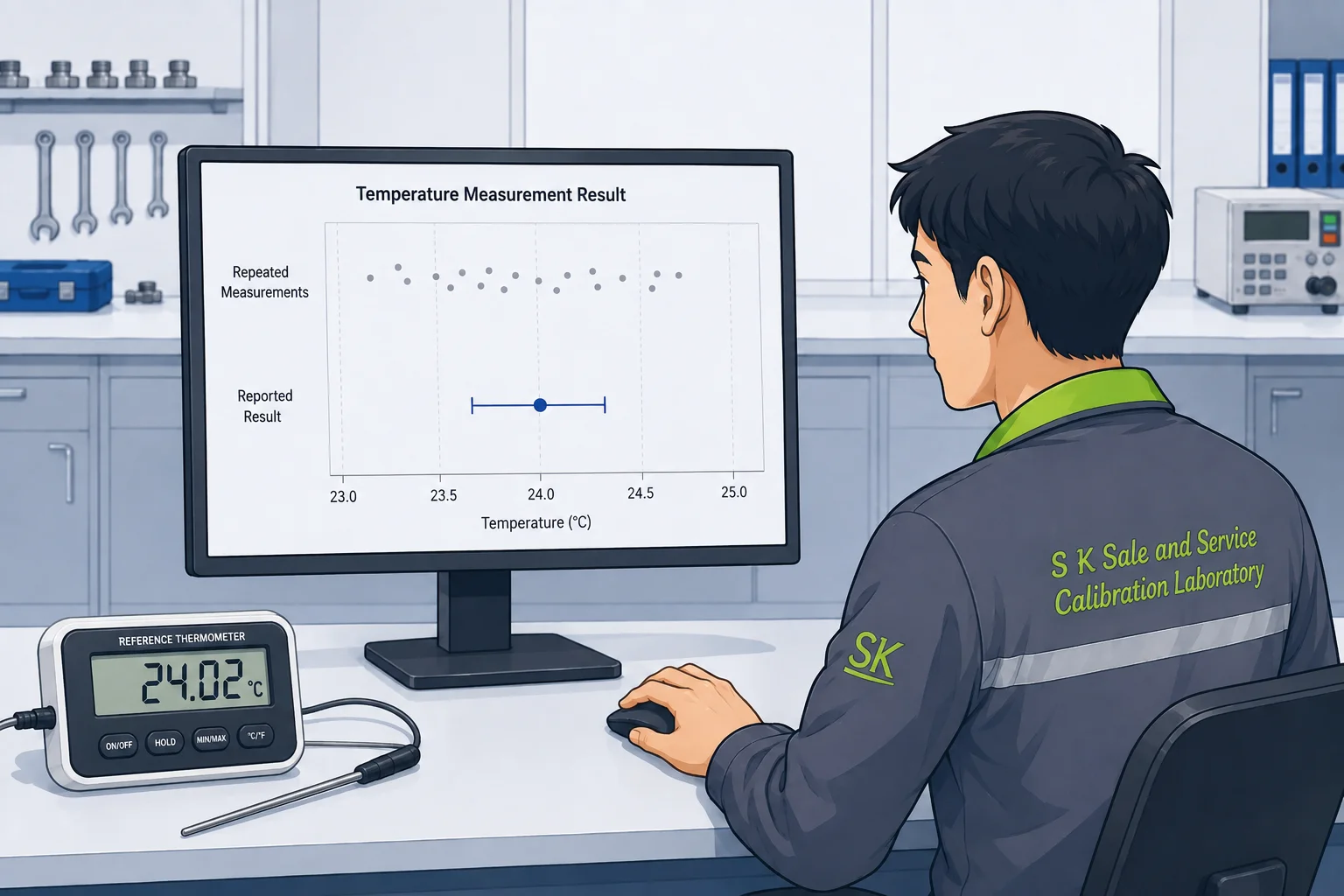
Uncertainty does not mean the measurement is wrong. It describes a reasonable range of doubt around the reported result arising from relevant sources of variation.
Where uncertainty comes from
Common sources include reference capability, instrument resolution, repeatability, environment, installation and the calculation model.
- Identify and standardize components
- Combine components using the measurement model
- Report expanded uncertainty and coverage factor
Using uncertainty in decisions
Compare results and uncertainty with limits under an agreed decision rule. Considering error alone may not address the full conformity risk.
- Define criteria before work
- Choose a risk-appropriate decision rule
- Keep units and confidence information consistent
FAQ
Is lower uncertainty always better?
Lower uncertainty can improve discrimination, but it must suit the intended use and come from a valid method. Conditions matter when comparing values.
How do error and uncertainty differ?
Error is the difference between an indication and a reference value. Uncertainty expresses doubt associated with the measurement result.